
Cozy games like Stardew Valley, Animal Crossing: New Horizons, and A Short Hike are redefining how players engage. These titles prove that emotionally satisfying, low-pressure game progression can drive deep user retention and long-term monetization.
As this genre continues to grow — with the cozy games market projected to hit over $1.4 billion by 2032 — publishers have a clear opportunity to meet players where they are with slower, more intentional mechanics. Milestone-based rewards are emerging as one of the best tools to support this kind of engagement, giving users meaningful goals without disrupting the calm.
In this piece, we’ll explore what the rise of cozy games signals about user behavior, and how growth teams can adapt their monetization and retention strategies accordingly.
The Cozy Game Phenomenon
Cozy games have been gaining traction because they offer something simple and satisfying. They focus on small-scale goals, steady progress, and emotional depth. Players spend time building, exploring, or connecting with characters in ways that feel meaningful rather than urgent. These experiences create space to relax and stay engaged over time, which is exactly what more people are looking for.
Titles like Stardew Valley, which has surpassed 41 million lifetime sales (copies sold) as of 2024, and Animal Crossing: New Horizons, a pandemic-era phenomenon, have shown that players are willing to invest hundreds of hours in games with no “winning”, but rather, gentle momentum.
Games like Unpacking and Spiritfarer (each with over 1 million copies sold) show how cozy design principles can scale commercially. Unpacking gained traction as a calm, tactile puzzle game centered on the emotional weight of everyday objects, while Spiritfarer introduced management gameplay with themes of care and letting go. A Short Hike, often described as a cozy adventure, has built a loyal following on Steam with strong player ratings and long-tail engagement, even without blockbuster sales numbers. Together, these titles underscore how smaller, emotionally resonant games are capturing attention — and holding it.
The popularity of cozy games reflects a broader shift in player psychology. After years of constant stimulation and the collective burnout of a global pandemic, many gamers are seeking refuge in emotionally restorative digital spaces. According to research by Sago, over 40% of UK players say they turn to cozy games to relax after a stressful day. And the market is responding: from just 15 cozy-tagged games on Steam in 2020 to over 370+ in 2024, genre growth has exploded.
![Cozy Game Market Growth [Graph] Line chart showing cozy-tagged games on Steam by year. 2020: 15 2022: ~150 2024: 373+](https://besitoscorp.com/wp-content/uploads/2025/12/Besitos_BlogImage1_WhyCozyGamesAreWinningAndWhatThatMeansForGamePublishers_v1-1024x683.png)
Long-Term Loyalty Doesn’t Require Fast Loops
There’s a long-held assumption in game monetization that faster loops equal better results. But cozy games challenge that idea. These titles show that when players are given room to progress at their own pace (without time pressure or constant nudges), they often stick around longer.
This isn’t anecdotal. Stardew Valley continues to attract millions of active players years after launch, and games like Animal Crossing: New Horizons saw users returning daily for months without any leaderboard or time-gated pressure. Cozy gameplay loops build emotional investment through low-stakes continuity rather than urgency.
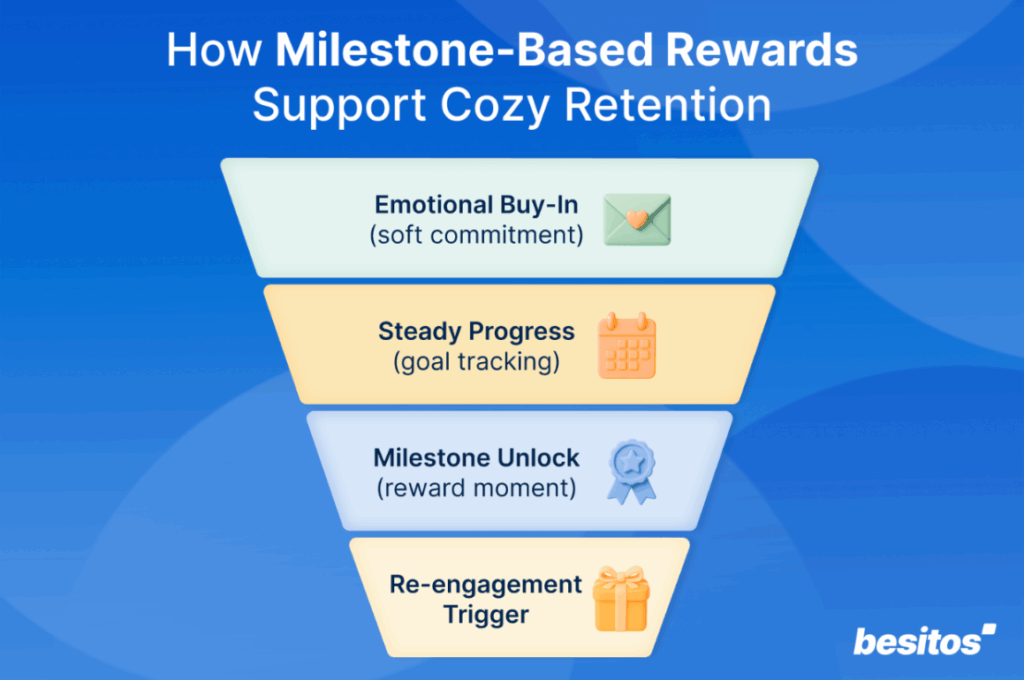
The data backs this up. Research into player motivation shows that milestone-driven progression, especially when tied to meaningful actions, significantly increases mid- to long-term retention. According to VideoCure, “achievement systems and progressive challenges create a clear path for advancement, giving members tangible goals to pursue,” which drives deeper engagement over time. These mechanics align perfectly with cozy games’ slower rhythms and give publishers tools to support that pacing without compromising monetization.
Cozy Gaming Signals a New Era of Engagement Design
Cozy games have introduced a design philosophy centered on simplicity, intentional pacing, and emotional presence. This shift has implications beyond the cozy genre. It challenges teams to revisit how systems support progress, motivation, and user satisfaction. Mechanics once considered secondary, like journaling features, passive unlocks, or quiet in-game rituals, are now driving core engagement loops.
For publishers, this is an opportunity to study what’s working and build systems that better align with how players actually play. The success of cozy games reflects broader shifts in how players want to engage, and smart teams will treat those mechanics as early signals, not outliers.
What Game Publishers Can Do Now
The cozy genre highlights a broader shift in player priorities, and with it, a new set of design and monetization opportunities. For studios building for long-term engagement, now is the time to reexamine how your systems invite players to stay.
Here are a few starting points:
1. Reevaluate What Progress Looks Like
Not all players are motivated by speed or volume. Build in systems that recognize steady engagement — things like milestone achievements, flexible quests, or time-independent challenges can extend LTV without relying on urgency mechanics.
2. Design for Intrinsic Momentum
Use game mechanics that reward curiosity, personal goals, and completion satisfaction. These don’t need to be flashy; even simple journaling systems or collectible progress maps can serve as internal motivators that keep players coming back.
3. Explore Tools That Enable Milestone-Based Rewards
If your game supports task-based progression, consider platforms that let you integrate milestone-based incentives without overhauling your core loop. The best tools allow for clean tracking, payout flexibility, and frictionless UX, especially when adapted to games with softer pacing.
4. Align Growth and Creative Teams Early
Retention doesn’t sit in a single department. Make sure your monetization and design teams are aligned on how players will feel as they progress. When systems support narrative, mood, and mechanics together, engagement becomes easier to sustain.
Transform Your Game’s Engagement With Besitos
Cozy games have shown there’s demand for systems that respect how players spend their time. If you’re working on ways to improve progression, retention, or the design of rewards, we can help.
We work with publishers to build engagement systems that support long-term play, flexible pacing, and measurable performance. Whether you’re evaluating milestone-based rewards or exploring new ways to drive user loyalty, let’s talk.
Contact us and let’s explore how to make engagement feel more rewarding for everyone.